
For much of the last decade, the cannabis cultivation industry was built around one overriding objective:
Grow more.
More canopy. More lights. More rooms. More pounds. More facilities.
When wholesale prices were high and new markets were opening, the economics could support that mentality. If a cultivation facility could produce another hundred pounds, operators could generally find somewhere to sell it.
That market no longer exists.
Across mature regulated cannabis markets, oversupply and price compression have fundamentally changed the economics of cultivation. In many markets, cultivators aren’t struggling because they can’t grow enough cannabis.
They’re struggling because they can’t grow it cheaply enough.
That distinction should change the way we design cannabis cultivation facilities.
“The cannabis industry doesn’t have a production problem. It has an efficiency problem.”
Yield Is No Longer Enough
For years, grams per square foot and pounds per light were among the industry’s favorite performance metrics.
They still matter.
But they don’t tell us whether a cultivation facility is actually a good business.
A facility producing exceptional yields while consuming enormous amounts of electricity, carrying excessive labor costs, fighting environmental inconsistencies and maintaining oversized mechanical systems may look productive from the grow room.
It can look very different on the P&L.
The metric that increasingly matters is much simpler:
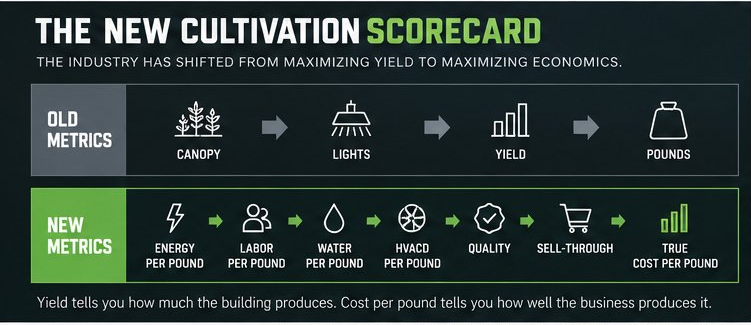
What does it cost to produce a sellable pound?
Underneath that number are several metrics sophisticated operators should understand:
- Energy consumed per pound
- HVACD cost per pound
- Labor hours per pound
- Water consumed per pound
- Facility overhead per pound
- Yield per square foot
- Crop failure and remediation rates
- Sell-through and realized price per pound
A cultivation facility should ultimately be evaluated as a manufacturing operation—not simply as a collection of grow rooms.
HVACD Has Become an Economic Issue
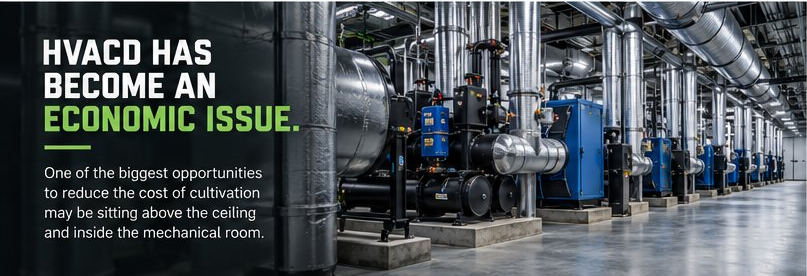
Environmental control has always been important in cannabis cultivation.
Today, it is an economic issue.
HVAC and dehumidification can represent one of the largest energy demands inside an indoor cultivation facility.
The implication is significant.
One of the largest opportunities to improve cultivation economics may be sitting above the ceiling and inside the mechanical room.
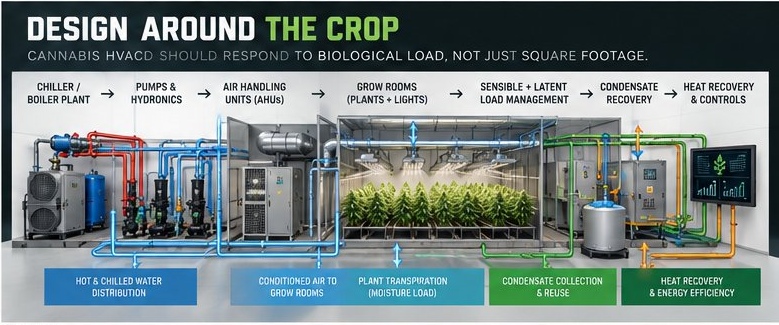
Cannabis presents an unusually complicated HVACD problem. Lights introduce large sensible loads. Plants introduce enormous latent loads through evapotranspiration. Those loads change throughout the crop cycle and between lights-on and lights-off periods.
Yet many facilities were designed around static peak-load assumptions.
The result can be oversized equipment, excessive cycling, inefficient standalone dehumidification, unnecessary reheat and environmental instability during partial-load conditions.
Bigger equipment isn’t necessarily better equipment.
The right system is the system capable of efficiently following the crop.
“One of the biggest opportunities to reduce the cost of cultivation may be sitting above the ceiling.”
Stop Designing Around Peak Load Alone
Peak conditions matter. A cultivation facility has to survive its worst-case design condition.
But plants don’t operate at peak load 24 hours a day.
Their moisture production changes throughout the growth cycle. Lighting schedules change loads dramatically. Outside conditions change. Irrigation events create moisture spikes. Rooms transition between crop cycles, cleaning and turnaround.
A mechanical system designed only around the maximum theoretical load can spend much of its operating life far below its design point.
That makes turndown, modulation and controls incredibly important.
Variable-capacity equipment, properly designed hydronic systems, integrated HVACD, heat recovery and intelligent controls can allow the mechanical infrastructure to respond to what is actually happening inside the cultivation environment.
That doesn’t mean every facility needs the most sophisticated mechanical system available.
It means the system should be engineered around the cultivation strategy instead of selecting equipment first and trying to make the grow fit it later.
Dehumidification Deserves More Attention
Moisture management remains one of the most misunderstood parts of cultivation facility design.
Plants move an extraordinary amount of water into the air.
That water has to go somewhere.
Historically, many facilities addressed the problem by installing cooling equipment and then adding standalone dehumidifiers when humidity became difficult to control.
That approach can work.
It can also create an expensive cycle in which equipment removes moisture, introduces heat into the space, and additional equipment then consumes more energy removing that heat.
Dehumidification cannot be an afterthought.
It needs to be part of the mechanical strategy from the beginning.
Your Plants Are Producing Water. Use It.
There is another overlooked opportunity:
Condensate.
Operators purchase, treat and deliver water to their plants. The plants transpire much of it into the cultivation environment. The mechanical system captures that water.
And many facilities send it down the drain.
With appropriate treatment, testing and system design, condensate recovery can potentially turn part of that waste stream back into a usable resource.
The same principle applies throughout cultivation infrastructure:
Heat can potentially be recovered.
Water can potentially be recovered.
Equipment can share loads.
Controls can coordinate systems.
Operational data can identify inefficiencies.
A properly designed cultivation facility is an interconnected biological and mechanical system.
The Cheapest Facility Isn’t Always the Least Expensive Facility
Cannabis construction has historically been heavily influenced by initial capital cost.
That’s understandable.
Capital is expensive, cannabis financing is difficult, and operators want facilities producing revenue as quickly as possible.
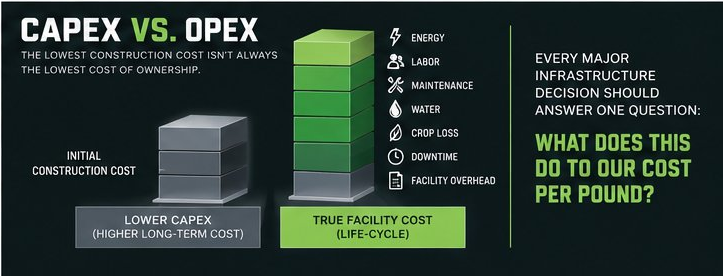
But there is an important difference between construction cost and life-cycle cost.
Saving money on mechanical infrastructure during construction can become extremely expensive when that equipment operates thousands of hours every year.
The opposite is also true.
Throwing expensive technology at a cultivation facility without demonstrating an operational return isn’t good engineering either.
Every major infrastructure decision should answer a simple question:
What does this do to the cost of producing a pound?
If a more expensive HVACD system meaningfully reduces annual energy consumption, improves environmental stability, protects yield and lowers maintenance costs, the higher initial investment may make sense.
If it doesn’t, it probably doesn’t belong in the project.
“Every major infrastructure decision should eventually answer one question: What does this do to our cost per pound?”
Existing Facilities May Have the Biggest Opportunity
This isn’t just a conversation about new construction.
There are millions of square feet of existing cannabis cultivation infrastructure across the United States that were designed under completely different market assumptions.
Some facilities were converted warehouses.
Some were expanded repeatedly.
Some contain multiple generations of HVAC equipment.
Some were designed quickly during licensing races when speed-to-market mattered more than long-term efficiency.
Those buildings shouldn’t automatically be written off.
They should be audited.
- Look at actual power consumption.
- Measure environmental performance.
- Evaluate equipment runtime.
- Review irrigation and transpiration data.
- Analyze room-to-room consistency.
- Identify simultaneous heating and cooling.
- Examine dehumidification performance.
- Compare energy consumption against actual harvested pounds.
The objective isn’t necessarily to replace everything.
It’s to determine where invested capital produces the greatest operational return.
Sometimes that means replacing equipment.
Sometimes it means controls.
Sometimes airflow.
Sometimes commissioning.
Sometimes changing cultivation practices.
And sometimes the best recommendation is to leave the equipment alone.
The Next Generation of Cannabis Cultivation Facilities
The first generation of legal cannabis infrastructure proved that cannabis could be cultivated at commercial scale.
The next generation has a different job.
It has to prove cannabis can be cultivated efficiently at commercial scale.
That means designing facilities around economics from the beginning.
Not maximum canopy.
Not the largest HVAC system.
Not the most lights that can physically fit inside a room.
Not technology for technology’s sake.
The winning cultivation facility will increasingly be the one that produces consistent, high-quality cannabis while using the least practical amount of energy, labor, water and capital to do it.
The industry’s question has changed.
It is no longer:
How much cannabis can this building grow?
The better question is:
How efficiently can this building turn resources into sellable product?
Because in today’s cannabis market, the facility that grows the most isn’t necessarily the facility that survives.
The facility with the best economics has the advantage.
Is Your Cultivation Facility Built for Today’s Market?
If your facility was designed during the industry’s race for canopy, its infrastructure may have been engineered for a cannabis market that no longer exists.
McCormick CEA Solutions works with cultivators, developers and capital partners to evaluate cultivation infrastructure from both sides of the equation:
How it gets built—and how it performs once the plants go in.
Whether you’re developing a new cultivation facility, evaluating an acquisition or trying to improve the economics of an existing operation, the conversation should start with the same question:
Where is the facility costing you money?
Facility Design | HVACD Strategy | Construction | Facility Audits | Optimization
McCormick CEA Solutions
Design • Build • Optimize.
Built for Yield.