
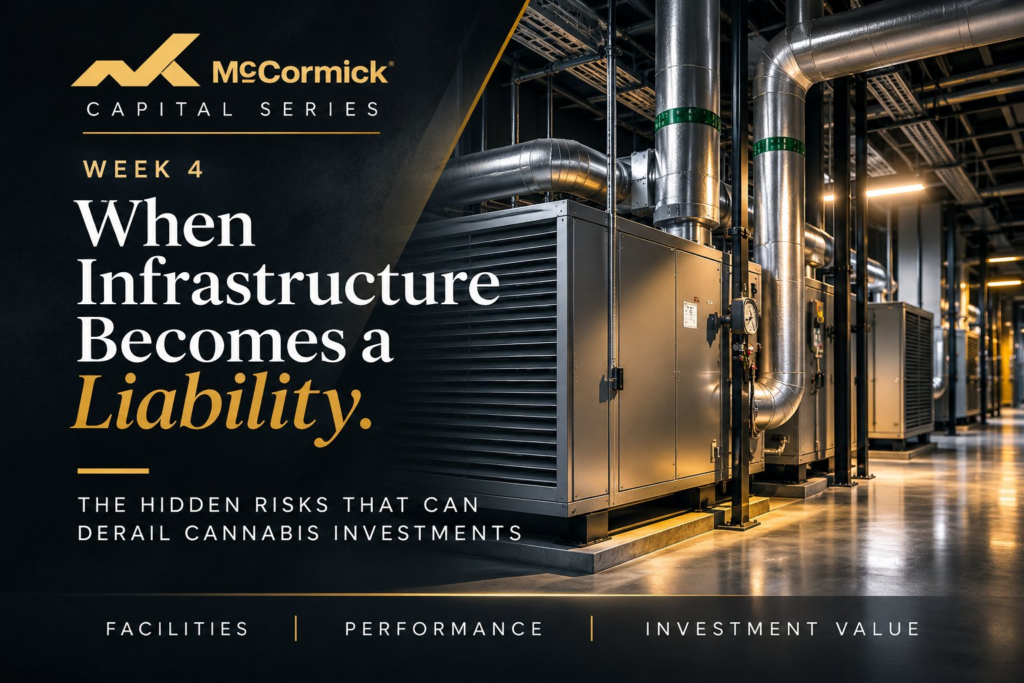
Capital Series | Week 4 — McCormick CEA
Not every struggling cannabis operation has a cultivation problem.
Sometimes the underlying problem is the facility itself.
A building that was poorly designed, inadequately commissioned, or constructed around unrealistic operating assumptions can become a significant financial liability.
For investors and owners, recognizing the difference between an operational problem and an infrastructure problem can determine whether additional capital creates value or compounds an existing loss.
The Problem With Sunk Costs
Cannabis facilities frequently represent substantial investments in specialized infrastructure.
Once that capital has been deployed, owners naturally want to preserve the investment.
But money already spent does not establish the economic value of an asset.
An HVAC system that cost millions to install may have limited economic value if it cannot maintain the required conditions efficiently.
Similarly, a building with substantial electrical infrastructure may require additional investment if the distribution system cannot accommodate the intended production strategy.
The relevant question is not what the equipment originally cost.
It is whether the infrastructure can support competitive operations today and into the future.
Five Infrastructure Warning Signs
1. Persistent Environmental Instability
Repeated temperature or humidity excursions may indicate inadequate capacity, poor equipment selection, control deficiencies, or insufficient commissioning.
The consequences can extend beyond utility expenses to crop quality, consistency, and production losses.
2. Excessive Energy Consumption
High utility costs should be evaluated against actual production requirements, equipment efficiency, operating schedules, and local energy rates.
An energy-intensive facility is not necessarily inefficient. The critical question is whether its consumption is appropriate for the output achieved.
3. Deferred Maintenance
Maintenance postponements can create cascading problems.
Equipment deterioration, control failures, leaks, and declining performance may eventually require more extensive repairs or replacements.
Deferred maintenance should be evaluated as a future capital obligation rather than simply a historical operating decision.
4. Infrastructure That Cannot Adapt
Cultivation strategies evolve.
Lighting technologies, plant densities, irrigation approaches, environmental setpoints, and production methods can change.
Facilities designed with limited flexibility may require expensive modifications to accommodate improved production strategies.
5. Repeated Emergency Repairs
Recurring mechanical and electrical failures may indicate that the facility is operating beyond its practical design capabilities.
Emergency repairs can keep production running temporarily without resolving the underlying problem.
Repair, Replace, or Reposition?
Not every deficiency justifies major reconstruction.
Owners should evaluate corrective options using a disciplined decision process.
Repair: Appropriate when the existing system remains fundamentally suitable and a targeted correction can restore reliable performance.
Replace: Appropriate when equipment is nearing the end of its useful life, cannot satisfy operational requirements, or is economically inefficient to maintain.
Reposition: Appropriate when the existing facility configuration no longer supports the intended business model and a broader redesign offers a credible path to improved economics.
The decision should account for construction cost, operational disruption, expected performance, remaining equipment life, and realistic payback.
Why Construction Planning Matters
Technical recommendations are only valuable when they can be executed.
Retrofitting an operating cultivation facility presents challenges that may not exist in new construction.
Mechanical shutdowns, contamination control, temporary environmental support, equipment access, permitting, and phased implementation can all influence project feasibility.
A technically attractive solution may be economically impractical if implementing it requires prolonged production interruptions.
These considerations belong in the financial analysis before the project is approved.
Distressed Assets Require a Different Perspective
When evaluating an underperforming or distressed facility, the objective should not automatically be restoring the building to its original design.
The original design may be part of the problem.
A more useful approach is to establish the facility’s realistic operating requirements, evaluate its existing infrastructure, and develop a corrective capital plan.
That plan may involve selective upgrades, system replacement, production reconfiguration, or alternative uses.
Sometimes the most valuable recommendation is to avoid further investment.
The McCormick CEA Perspective
McCormick CEA connects infrastructure assessment with construction planning and implementation.
Our objective is to help owners and capital providers distinguish between deficiencies that can be corrected and fundamental limitations that threaten the economics of an investment.
A facility becomes a liability when the cost of operating, maintaining, or correcting it exceeds the economic value it can reasonably produce.
Understand the Cost Before Committing More Capital
McCormick CEA supports facility assessments, corrective construction planning, infrastructure upgrades, and repositioning strategies for underperforming cultivation assets.
McCormick CEA — Design • Build • Optimize