
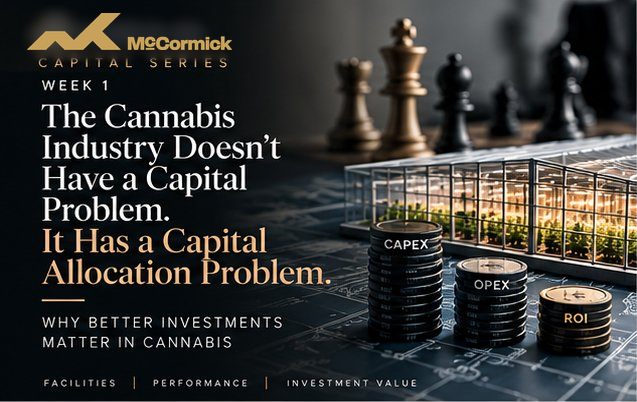
Why the next generation of cannabis investments should focus less on how much capital gets deployed—and more on what that capital actually produces.
Cannabis Capital & Infrastructure | Week 1 of 6
For much of the past decade, the cannabis industry has operated under one recurring assumption:
More capital creates more opportunity.
More funding.
More licenses.
More canopy.
More facilities.
More production.
More market share.
And during the industry’s early expansion, that mentality wasn’t entirely unreasonable.
New markets were opening. Wholesale prices were attractive. Demand appeared to be growing. Investors were willing to fund aggressive expansion strategies built around capturing market share before competitors arrived.
But the economics have changed.
Wholesale price compression, oversupply, regulatory uncertainty and limited access to conventional financing have fundamentally altered the investment landscape.
Today, cannabis operators face genuine capital constraints.
But there’s another problem that deserves just as much attention.
How effectively is the capital already invested in cannabis infrastructure being utilized?
Because raising more money doesn’t automatically create a better business.
And building more cultivation capacity doesn’t necessarily create more value.
Capital doesn’t create value simply because it’s deployed. It creates value when the assets it funds can produce an economic return.
The Industry Has Spent Billions Building Capacity
Across regulated cannabis markets, significant capital has been invested in cultivation, processing, manufacturing and retail infrastructure.
Some of those investments created productive, efficient facilities.
Others were developed under assumptions that no longer reflect today’s market.
Facilities were designed around aggressive production forecasts.
Mechanical systems were selected for anticipated expansion.
Buildings were constructed to accommodate future canopy that never materialized.
Operators invested heavily in infrastructure before establishing sustainable demand.
And in some cases, the cost of developing a facility became disconnected from the economics of operating it.
The result?
An industry containing substantial physical infrastructure that isn’t always being utilized efficiently.
That’s not simply a financing problem.
It’s a capital allocation problem.
More Canopy Doesn’t Automatically Mean More Revenue
Cannabis cultivation has historically been driven by production metrics.
Square footage.
Number of lights.
Pounds per harvest.
Annual production capacity.
Those numbers matter.
But they don’t tell the entire financial story.
A facility capable of producing 10,000 pounds annually isn’t necessarily more valuable than one producing 6,000 pounds.
Not if the larger facility carries significantly higher operating expenses, requires additional capital investment or produces inventory that cannot be sold profitably.
The more important questions are:
What does each pound cost to produce?
What price can the operator realistically achieve?
What percentage of production is sold?
How much capital is required to sustain the operation?
What return does the infrastructure generate?
Production capacity is not the same thing as economic productivity.
And the distinction becomes increasingly important as markets mature.
The Most Expensive Square Foot May Be the One You Didn’t Need
One of the most consequential decisions in cultivation development occurs before construction begins.
How much facility should we actually build?
Too often, that question is answered using optimistic assumptions.
Projected demand.
Future market share.
Anticipated wholesale prices.
Expected licensing opportunities.
Potential expansion.
But every additional square foot introduces cost.
Construction.
Mechanical capacity.
Electrical infrastructure.
Environmental controls.
Maintenance.
Property expenses.
And eventually, operating overhead.
Even unused space can carry financial obligations.
A facility built substantially larger than current demand requires may tie up capital that could have been deployed more productively elsewhere.
That doesn’t mean operators shouldn’t plan for growth.
It means growth should be supported by realistic economics.
Design for expansion. But don’t necessarily pay for all of it on day one.
The most profitable square foot may be the one you never built.
Capital Expenditure and Capital Efficiency Are Different Things
Consider two hypothetical cultivation projects.
Project A
A $20 million facility designed for maximum production capacity from the beginning.
The project includes extensive mechanical infrastructure, electrical distribution, multiple cultivation rooms and substantial future production capacity.
But market conditions prevent the operator from utilizing the facility at its intended capacity.
Project B
A $12 million facility designed around verified initial production requirements, with infrastructure strategically planned for future expansion.
The operator begins with lower fixed costs, measures performance and adds capacity when demand supports the investment.
Project A may eventually become the better investment.
But that outcome depends on utilization, margins, future expansion costs and actual market demand.
The larger project isn’t automatically superior because it contains more infrastructure.
The smaller project isn’t automatically superior because it costs less.
The right decision requires evaluating the relationship between:
Capital Invested → Productive Capacity → Operating Cost → Revenue → Return
That’s capital efficiency.
And it’s where facility design becomes an investment decision.
The Building Should Support the Business Model
A cultivation facility is not simply a real estate asset.
It’s a specialized manufacturing environment.
Lighting, HVACD, irrigation, water treatment, electrical infrastructure, controls and building-envelope performance all influence the economics of production.
A poorly designed facility can consume substantial operating capital even when the cultivation team performs well.
An oversized mechanical system can create unnecessary capital expense and inefficient operation.
An undersized system can jeopardize production.
An inefficient layout can increase labor requirements.
Poor environmental control can reduce consistency and quality.
And inadequate coordination between systems can create expensive corrective work.
These aren’t isolated construction issues.
They’re investment-performance issues.
That’s why facility infrastructure needs to be evaluated alongside the business model—not after the financial assumptions have already been established.
The Next Dollar Should Have a Job
When capital becomes constrained, every additional dollar deserves scrutiny.
Before expanding canopy, ask whether existing rooms are operating efficiently.
Before purchasing additional HVAC equipment, verify the actual mechanical deficiency.
Before developing another facility, evaluate whether existing infrastructure can be improved or repositioned.
Before acquiring an asset, understand its deferred capital requirements.
Before funding construction, verify that the proposed infrastructure supports the intended production strategy.
The question shouldn’t simply be:
Can we fund this project?
It should be:
What measurable economic improvement is this capital expected to create?
More productive capacity?
Lower operating costs?
Improved product consistency?
Reduced downtime?
Better utilization?
Lower risk?
If the answer isn’t clear, the investment deserves further evaluation.
Existing Infrastructure May Offer the Greatest Opportunity
Not every improvement requires new construction.
There are cultivation facilities operating today with significant opportunities to improve performance.
Some contain inefficient HVACD systems.
Some have poorly integrated controls.
Some suffer from building-envelope deficiencies.
Some have underutilized electrical or mechanical capacity.
Some were designed for cultivation strategies that have since changed.
Others simply haven’t been comprehensively evaluated since becoming operational.
In these situations, the most productive investment may be a targeted improvement rather than a major expansion.
A facility performance assessment can help identify where additional capital is likely to create measurable value.
Sometimes the answer is new equipment.
Sometimes it’s controls.
Sometimes it’s airflow.
Sometimes it’s commissioning.
Sometimes it’s operational changes.
And sometimes the right answer is to leave the infrastructure alone.
Good capital allocation doesn’t always mean spending more money.
Sometimes it means understanding why you’re spending it.
Capital Providers Need Better Facility Intelligence
Lenders and investors traditionally evaluate financial statements, operating projections, market conditions, management teams and collateral.
Those are essential considerations.
But specialized cultivation infrastructure introduces another layer of risk.
What condition is the facility in?
What is the remaining useful life of major equipment?
How efficiently does the building operate?
What capital expenditures are approaching?
Does the infrastructure support the projected production model?
Can the asset be repositioned if the current operation fails?
How much of the original construction investment retains productive value?
These questions can materially influence the investment thesis.
And they cannot always be answered through financial diligence alone.
Capital providers need an owner-side understanding of the physical infrastructure supporting their investment.
That is where technical due diligence, CAPEX underwriting and facility performance assessments become valuable.
The Next Phase of Cannabis Investment Requires Discipline
The industry’s early expansion rewarded speed.
Secure licenses.
Acquire property.
Build capacity.
Enter markets.
Establish market share.
But mature markets increasingly reward something different.
Efficiency.
Utilization.
Cost control.
Operational consistency.
Disciplined capital deployment.
That doesn’t mean the industry should stop building.
It means construction should follow a clear economic purpose.
Facilities should be right-sized.
Infrastructure should be evaluated on lifecycle performance.
Expansion should be supported by realistic demand.
And capital should be deployed where it creates measurable value.
It’s Not Just About Raising More Capital
Cannabis operators still face substantial financing challenges.
Federal restrictions, banking limitations, taxation and market uncertainty continue to influence access to capital.
Those problems are real.
But additional financing alone won’t correct inefficient infrastructure or poor investment decisions.
An underperforming facility doesn’t become economically sound simply because another investor writes a check.
A poorly planned expansion doesn’t become a good investment because the capital is available.
And a building doesn’t become more valuable simply because more money was spent constructing it.
The next generation of cannabis investment needs to ask harder questions.
Not just how much capital can be raised.
But where it should go.
Not just how much capacity can be built.
But how much productive capacity is actually needed.
Not just what an asset cost.
But what it can economically produce.
The industry’s capital challenge isn’t only about access to money. It’s about making better decisions with the money available.
And that’s where the next phase of value creation begins.
McCormick CEA Solutions | Capital Technical Advisory
Owner-side facility intelligence for cannabis investors, lenders and operators.
McCormick CEA Solutions combines commercial construction, controlled-environment agriculture and facility infrastructure experience to help capital providers understand the physical assets supporting their investments.
ACQUIRE
Technical Due Diligence + CAPEX Underwriting
Evaluate facility condition, infrastructure risks and anticipated capital requirements before committing investment capital.
DEPLOY
Construction Monitoring + Capital Oversight
Assess project progress, infrastructure decisions and capital deployment throughout development and construction.
RECOVER
Distressed Asset Assessment + Repositioning
Evaluate underperforming assets, identify recoverable infrastructure and develop practical strategies for improvement or alternative use.
Better infrastructure decisions. Better capital decisions.
McCormick CEA Solutions
Design • Build • Optimize.
Built for Yield.