
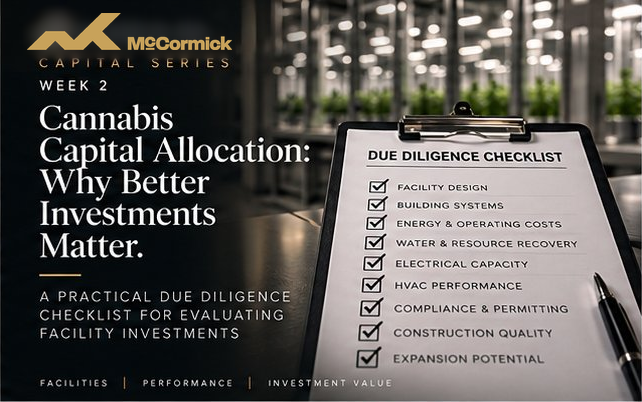
A Practical Due Diligence Checklist for Evaluating Facility Investments / Cannabis Capital & Infrastructure | Week 2 of 6
The cannabis industry has no shortage of distressed assets.
Facilities that cost millions to develop are sitting idle.
Cultivation operations have closed.
Equipment has been abandoned, removed or left deteriorating.
Investors have taken losses. Lenders are holding specialized real estate. Ownership groups are searching for ways to recover whatever value remains.
And increasingly, buyers are looking at these properties as potential opportunities.
On the surface, the attraction is understandable.
A cultivation facility that originally cost $20 million to develop might become available for a fraction of that investment.
The building exists.
The electrical infrastructure is installed.
Mechanical equipment is in place.
Cultivation rooms have already been constructed.
Surely there’s value in all of that.
There may be.
But there’s a question that needs to be answered before celebrating the discounted purchase price.
Why did the business fail in the first place?
And perhaps more importantly:
Did the building contribute to that failure?
Because distressed doesn’t necessarily mean worthless.
But cheap doesn’t necessarily mean recoverable.
A Failed Business Doesn’t Always Mean a Failed Building
Cannabis businesses fail for many reasons.
Poor management.
Inadequate capitalization.
Unfavorable market conditions.
Regulatory complications.
Wholesale price compression.
Excessive debt.
Operational inefficiencies.
Some of those failures have relatively little to do with the physical facility.
An otherwise efficient cultivation building may have been operated by a company with an unsustainable financial structure.
A well-designed facility may have been developed in a market that became oversupplied.
A business may have failed because of decisions made outside the cultivation operation entirely.
In those situations, the infrastructure may retain substantial productive value.
A new operator, different capital structure or revised business strategy could potentially create a viable opportunity.
But there’s another possibility.
What if the building itself was part of the problem?
Sometimes the Infrastructure Is the Business Problem
A cultivation facility can be structurally sound, mechanically operational and visually impressive while being economically uncompetitive.
Consider a facility with excessive energy consumption.
Its HVACD systems may be inefficient or poorly matched to actual cultivation loads.
Its building envelope may allow substantial heat transfer or uncontrolled infiltration.
Its environmental controls may struggle to coordinate heating, cooling and dehumidification.
Its room layouts may require unnecessary labor.
Its equipment may demand frequent maintenance.
Individually, these deficiencies might appear manageable.
Collectively, they can create an operating-cost structure that makes profitable cultivation extremely difficult.
And unlike genetics, cultivation techniques or management personnel, infrastructure problems cannot always be corrected quickly.
A new operator can change the cultivation strategy. They cannot necessarily change the economics of the building without substantial capital investment.
That’s why understanding historical operating expenses should be part of the earliest stages of distressed-asset evaluation.
Not an afterthought.
Not something examined only after purchasing the property.
A primary screening consideration.
CAPEX Tells You What It Costs to Recover. OPEX Tells You Whether Recovery Makes Sense.
Most buyers understand the importance of evaluating capital expenditures.
What equipment needs replacing?
What repairs are required?
How much will it cost to restart the facility?
What improvements are necessary to support the intended operation?
Those are essential questions.
But capital expenditure is only half the equation.
Operating expenditure determines what happens after the building comes back online.
Electricity.
Heating and cooling.
Dehumidification.
Water.
Maintenance.
Repairs.
Facility-related labor.
These costs continue long after the acquisition and rehabilitation budgets have been spent.
A facility purchased at an attractive discount can become an expensive mistake if its operating costs prevent competitive production.
Conversely, a facility requiring meaningful upfront improvements may represent an excellent opportunity if those investments substantially reduce long-term operating expenses.
The relationship between acquisition cost, rehabilitation CAPEX and achievable future OPEX is what determines whether the infrastructure can support a viable business model.
A discounted purchase price doesn’t fix an expensive building.
Start With the Utility Bills
One of the first things I’d want to see when evaluating a distressed cultivation facility is its historical utility consumption.
Ideally, 12 to 24 months of records.
Not just the total annual electricity expense.
Monthly consumption.
Peak demand.
Demand charges.
Seasonal variation.
Historical production.
Room utilization.
And, where submetering exists, the electrical consumption associated with HVACD, lighting and other major systems.
Why?
Because electricity is often one of the largest facility-related operating expenses in controlled-environment agriculture.
But total electricity consumption alone doesn’t tell us enough.
A large facility consuming substantial energy may still be highly efficient if it produces enough sellable product.
A smaller facility with lower utility bills may be considerably less efficient on a per-pound basis.
That’s why the relationship between energy consumption and production matters.
Electricity Cost per Sellable Pound = Total Electricity Expense ÷ Sellable Pounds Produced
We can also examine:
- Energy consumption per sellable pound
- HVACD energy consumption per pound, where measurable
- Water consumption and treatment cost per pound
- Maintenance expenditure per year
- Facility-related labor cost per pound
- Actual production versus designed production capacity
- Fixed facility operating costs
- Total facility OPEX per sellable pound
These metrics begin to reveal whether the building supports competitive production economics.
They also help identify where targeted improvements might create value.
Importantly, we need to distinguish infrastructure-related costs from problems caused by cultivation practices, management or other business decisions.
Otherwise, we risk blaming the building for an operating problem—or overlooking an infrastructure problem because the previous operator performed poorly.
Two Buildings. Two Very Different Opportunities.
Consider two hypothetical distressed cultivation facilities.
Both originally cost $15 million to develop.
Both are available for $4 million.
Both contain similar canopy square footage.
Both appear to be in reasonable physical condition.
But their operating histories tell different stories.
Facility A
The previous operator struggled with debt, market conditions and management challenges.
The building’s mechanical infrastructure is relatively efficient.
Historical maintenance costs are manageable.
Environmental performance is consistent.
The facility can support a competitive cost of production under realistic operating assumptions.
The business failed.
But the building may still be a valuable asset.
Facility B
The previous operator also struggled financially.
However, its mechanical systems consume excessive energy.
The building envelope performs poorly.
Environmental controls are outdated.
Maintenance costs are elevated.
Production efficiency suffers from infrastructure limitations.
Even under improved management, the building’s operating costs remain significantly above what the market can support.
Both properties have the same asking price.
Both represent substantial discounts to original construction cost.
But they are not equivalent investments.
Facility A may need a new business strategy. Facility B may need an entirely new infrastructure strategy.
And the economics of correcting Facility B may or may not justify the investment.
That’s the difference between identifying a distressed asset and identifying a recoverable asset.
The Right Improvements Can Change the Equation
Not every inefficient facility should be avoided.
Sometimes, relatively targeted investments can create meaningful improvements in operating performance.
Consider another hypothetical example.
A distressed cultivation facility has annual facility-related operating expenses of $1.5 million at its historical production level.
A technical assessment identifies opportunities involving environmental controls, mechanical-system optimization and building-envelope improvements.
The estimated improvement cost is $500,000.
Engineering analysis suggests those improvements could reduce annual operating expenses by approximately $250,000, assuming similar production conditions.
On a simplified basis, that represents a two-year payback.
Of course, the actual investment decision must account for financing, implementation downtime, taxes, maintenance, production changes and uncertainty in projected savings.
But the principle is important.
A facility that was economically unattractive under its previous operating conditions may become viable through targeted infrastructure improvements.
Now consider the opposite scenario.
The same facility requires $4 million in mechanical replacements, electrical upgrades and building modifications to achieve competitive operating costs.
Suddenly, the investment thesis changes considerably.
The question is no longer whether the acquisition price is attractive.
It’s whether the total capital required can generate an acceptable return.
Not Every Problem Requires New Equipment
This is another distinction worth making.
When a cultivation facility struggles to maintain environmental conditions, the immediate reaction is often to replace or add mechanical equipment.
But equipment replacement isn’t always the solution.
The underlying problem may involve:
Poorly configured controls.
Improper airflow.
Inadequate commissioning.
Sensor placement.
Building-envelope deficiencies.
Uncoordinated operating sequences.
Changes in cultivation loads.
Or simply equipment that hasn’t been maintained properly.
Replacing functioning equipment without diagnosing the underlying problem can waste capital and leave the original deficiency unresolved.
That’s why technical assessments should focus on identifying root causes.
The goal isn’t to determine how much equipment can be replaced. It’s to determine what investment, if any, will improve the economics of the facility.
Four Possible Outcomes for a Distressed Facility
A disciplined assessment should lead toward one of four preliminary conclusions.
- Operate As-Is
The infrastructure is fundamentally sound.
Historical or projected operating costs are competitive.
Major capital requirements are limited.
The previous business may have failed for reasons largely unrelated to the building.
This asset may offer an opportunity for a qualified operator with an appropriate business model.
- Recover
The facility contains substantial reusable infrastructure, but targeted repairs, upgrades or operational improvements are necessary.
The required capital can be reasonably estimated.
Projected performance improvements may justify the investment.
The asset has a plausible path back to productive operation.
- Reposition
The existing cultivation model no longer makes economic sense.
However, the building may retain value for a different cultivation strategy, processing operation, conventional industrial use or another permitted purpose.
Electrical capacity, mechanical infrastructure, structural characteristics and location may support alternative uses.
Repositioning should be evaluated against conversion costs, regulatory requirements and realistic market demand.
- Pass or Hold
The facility has substantial unresolved deficiencies.
The required investment may exceed its realistic economic potential.
Regulatory, environmental or infrastructure constraints may make recovery impractical.
Or there simply isn’t enough reliable information to support an investment decision.
Sometimes the most valuable conclusion from technical due diligence is that the buyer should walk away.
Not every distressed asset deserves to be rescued.
A Practical Starting Point: The 30-Point Recovery Checklist
Before commissioning a comprehensive engineering and financial assessment, buyers and capital providers can begin with a structured initial screening.
At McCormick CEA Solutions, we’ve organized that screening around four areas:
Business Failure & Market Context
Why did the previous operation fail? What market, financial, licensing or management issues contributed?
Historical OPEX & Production
What did the building cost to operate? How much sellable product did it produce? Which expenses were driven by the infrastructure?
Physical Infrastructure
What is the condition of the building, HVACD, electrical systems, controls, water infrastructure and specialized equipment?
CAPEX & Recovery Economics
What capital is required to stabilize, rehabilitate or reposition the asset? Can the resulting operation support a realistic financial return?
The checklist isn’t a substitute for professional due diligence.
It’s a way to identify the questions that need answers before committing additional capital.
Download the McCormick CEA 30-Point Distressed Asset Recovery Checklist
The Real Opportunity Is Understanding What Remains
The cannabis industry has invested enormous amounts of capital into specialized infrastructure.
Some of those facilities will never return to their original intended use.
Others may become productive again under new ownership.
Some may require substantial rehabilitation.
And others may hold more value as alternative-use properties than as cultivation operations.
The challenge for investors, lenders and property owners is distinguishing among them.
That requires more than reviewing the original construction budget.
More than inspecting the equipment.
More than comparing the asking price with what the facility once cost.
It requires understanding the building’s physical condition, operating economics, future capital requirements and realistic productive potential.
The business may have failed. The building hasn’t necessarily lost its value.
But the only way to know is to examine both what it will cost to recover—and what it will cost to operate afterward.
Because distressed doesn’t mean worthless.
And cheap doesn’t mean recoverable.
McCormick CEA Solutions | Capital Technical Advisory
Owner-side facility intelligence for cannabis investors, lenders and operators.
McCormick CEA Solutions combines commercial construction and controlled-environment agriculture experience to help capital providers understand the physical and economic characteristics of specialized cultivation infrastructure.
ACQUIRE
Technical Due Diligence + CAPEX Underwriting
Assess infrastructure condition, historical operating performance and anticipated capital requirements before an acquisition.
DEPLOY
Construction Monitoring + Capital Oversight
Evaluate capital deployment, construction progress and infrastructure decisions during facility development or rehabilitation.
RECOVER
Distressed Asset Assessment + Repositioning
Identify reusable infrastructure, evaluate rehabilitation economics and develop practical strategies for returning assets to productive use.
Understand the building. Understand the economics. Protect the capital.
McCormick CEA Solutions
Design • Build • Optimize.
Built for Yield.