
Why technical due diligence and CAPEX underwriting should be part of every cannabis facility acquisition.
The Cultivation Economics Series | Week 5 of 6
The canopy looks beautiful.
The rooms are clean.
LED fixtures hang in perfect rows.
The cultivation team speaks confidently about yields, genetics and production capacity.
Ownership walks you through historical harvest data.
The facility may have cost tens of millions of dollars to develop.
Everything looks impressive.
But before you decide what the operation is worth, there’s something else you should examine.
Look above the ceiling.
Because some of the most expensive liabilities in a cannabis cultivation facility are the things investors never see during the tour.
And unlike a struggling crop, those problems can’t always be corrected in the next cultivation cycle.
You’re Not Just Buying a Cannabis Operation. You’re Buying Infrastructure.
A commercial cultivation facility is an interconnected collection of biological, mechanical, electrical and operational systems.
When you acquire one, you’re not simply purchasing canopy, equipment and real estate.
You’re inheriting years of infrastructure decisions.
Some were well considered.
Others may have been driven by aggressive construction schedules, limited capital, licensing deadlines or operating assumptions that no longer apply.
You’re acquiring HVACD systems, chillers, boilers, pumps, electrical distribution, environmental controls, irrigation infrastructure, water treatment, building-envelope assemblies and specialized cultivation equipment.
And you’re inheriting the condition, maintenance history and remaining useful life of every one of those systems.
The purchase price tells you what you’re paying for the asset. It doesn’t necessarily tell you what you’ll have to spend to keep it operating.
That’s where technical due diligence becomes critical.
“Before you underwrite the deal, underwrite the building.”
Purchase Price Isn’t Total Acquisition Cost
Consider a hypothetical acquisition.
A buyer identifies an attractive cultivation facility with established production history and a purchase price substantially below its original development cost.
The opportunity looks compelling.
But six months after closing, the buyer discovers:
- Several HVAC units are approaching replacement.
- The chiller plant requires major repairs.
- Environmental controls are outdated or poorly integrated.
- Electrical infrastructure cannot support the buyer’s intended cultivation strategy.
- Building-envelope deficiencies are contributing to moisture problems.
- Deferred maintenance has accumulated across multiple systems.
Suddenly, the acquisition requires significantly more capital than originally anticipated.
And those repairs may involve taking cultivation rooms offline, reducing production while corrective work is performed.
The actual investment now looks more like:
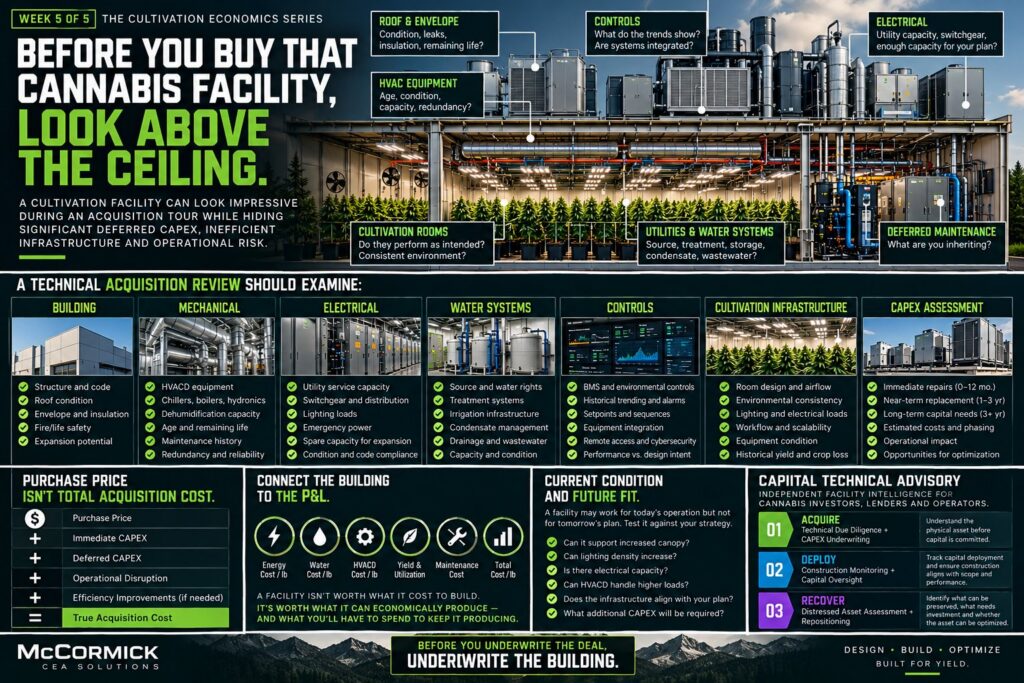
Purchase Price + Immediate CAPEX + Deferred CAPEX + Operational Disruption + Required Improvements
That’s a very different financial equation.
The objective of technical due diligence isn’t to eliminate every potential risk.
It’s to identify, quantify and prioritize infrastructure risks before capital is committed.
Start With the Mechanical Infrastructure
In conventional commercial real estate, HVAC is primarily associated with occupant comfort.
In controlled-environment agriculture, HVACD is process infrastructure.
The crop depends on it.
Temperature, humidity, airflow and vapor pressure deficit all influence cultivation performance.
A mechanical system that fails to maintain the required environment can jeopardize production, product quality and operating margins.
An acquisition assessment should go beyond confirming that equipment turns on.
It should examine:
Equipment condition. What is installed, how old is it, and what is its expected remaining useful life?
System capacity. Can the infrastructure handle the actual sensible and latent loads generated by the cultivation operation?
Redundancy. What happens when a critical piece of equipment fails?
Efficiency. How much energy does the mechanical system consume relative to production?
Maintainability. Can equipment be serviced or replaced without significant operational disruption?
Controls integration. Are cooling, heating, dehumidification and environmental controls functioning as a coordinated system?
A relatively new mechanical system isn’t necessarily a good system.
And an older system isn’t automatically a liability.
Condition, performance and suitability matter more than appearance.
Electrical Capacity Can Make or Break the Business Plan
Cannabis cultivation facilities are energy-intensive buildings.
Lighting, HVACD, irrigation, processing and environmental controls all compete for electrical capacity.
An acquisition team needs to understand both existing infrastructure and the requirements of its intended operating model.
What is the available utility service?
What is the historical peak demand?
How much spare capacity exists?
Can the distribution system accommodate future expansion?
Will a different lighting strategy change the mechanical and electrical loads?
Is emergency power adequate for critical operations?
Are major electrical upgrades required?
These questions become particularly important when the buyer intends to change the cultivation strategy.
A building that adequately supports the current operator may not support the next operator’s business plan.
Existing capacity and usable capacity are not always the same thing.
The Building Envelope Deserves More Attention
Mechanical and electrical equipment often receive the most attention during facility evaluations.
But the building itself can create significant operating liabilities.
Poor insulation.
Uncontrolled infiltration.
Thermal bridging.
Improper vapor-control strategies.
Moisture intrusion.
Roof deficiencies.
Unsealed penetrations.
These conditions can increase mechanical loads, create environmental instability and contribute to long-term building deterioration.
In cultivation environments, where temperature and humidity differentials can be substantial, building-envelope performance deserves careful consideration.
A facility may have excellent mechanical equipment and still struggle because the building is working against it.
Replacing HVAC equipment won’t necessarily solve a poorly performing envelope.
Controls Can Tell You What the Building Has Been Doing
One of the most valuable sources of information during a technical assessment may already exist inside the facility.
Historical operating data.
Environmental controls and building management systems can provide insight into how the infrastructure has performed over time.
Temperature excursions.
Humidity spikes.
Equipment runtime.
Recurring alarms.
Setpoint changes.
Simultaneous heating and cooling.
Rooms that consistently struggle to maintain conditions.
Systems operating near maximum capacity.
When reliable historical data is available, it can help distinguish between an isolated problem and a recurring operational deficiency.
That’s an important distinction.
An equipment inspection tells you what condition the system appears to be in today.
Operating history can help reveal how the system has actually been performing.
Deferred Maintenance Is Deferred Capital Expenditure
A cultivation facility can remain operational while accumulating substantial technical debt.
Filters get replaced late.
Coils deteriorate.
Pumps wear.
Sensors drift.
Valves fail.
Controls become obsolete.
Roof problems receive temporary repairs.
Equipment reaches the end of its useful life.
Individually, these issues may appear manageable.
Collectively, they can represent a significant capital obligation.
A meaningful technical assessment should categorize deficiencies into:
Immediate corrective work: Safety, compliance, reliability and critical operational issues requiring prompt attention.
Near-term CAPEX: Equipment repairs and replacements likely required within the next 12–24 months.
Medium-term CAPEX: Anticipated infrastructure investments over the following several years.
Long-term capital planning: Major system replacements, modernization and potential facility repositioning.
This allows buyers and lenders to distinguish between the price of the acquisition and the capital required to sustain the asset.
“Deferred maintenance doesn’t disappear during an acquisition. It changes owners.”
Don’t Confuse Original Construction Cost With Current Value
This is particularly important in cannabis.
A cultivation facility may have required $20 million, $40 million or more to develop.
That doesn’t mean its infrastructure retains that value.
Some facilities were constructed during periods when wholesale cannabis prices were substantially higher.
Others were built under pressure to enter emerging markets quickly.
Some contain oversized equipment, inefficient layouts or infrastructure designed around cultivation strategies that have since changed.
And some facilities simply cost more to build than their present economics can justify.
Historical construction cost tells you how much capital was invested.
It doesn’t necessarily tell you how much productive value remains.
A cultivation facility isn’t worth what it cost to build. Its economic value depends on what it can produce, what it costs to operate and what capital is required to sustain that production.
That distinction matters when underwriting an acquisition.
Connect the Infrastructure to the P&L
Technical due diligence becomes particularly valuable when physical infrastructure is evaluated alongside operational economics.
It’s not enough to know that a chiller operates.
We need to understand what that chiller contributes to the cost of production.
Consider the following metrics:
- Energy consumption per sellable pound
- Water consumption per pound
- HVACD operating cost per pound
- Maintenance expenditure
- Equipment downtime
- Room utilization
- Environmental consistency
- Historical crop losses
- Actual production versus designed capacity
These metrics help connect the building to the financial performance of the operation.
A facility may produce excellent yields while carrying an unsustainable operating cost.
Another facility may produce less cannabis but operate with significantly better margins.
Production capacity is not the same thing as economic productivity.
And for capital providers, that distinction should influence valuation, underwriting and investment decisions.
Underwrite the Buyer’s Plan, Not Just the Seller’s Operation
An acquisition assessment shouldn’t stop at documenting existing conditions.
It should also evaluate what the buyer intends to do with the property.
Will canopy increase?
Will lighting density change?
Will cultivation methods be modified?
Will environmental setpoints change?
Will processing operations be added?
Will production be consolidated from other facilities?
Will the building be repositioned for a different use?
Each of those decisions can affect infrastructure requirements.
A facility may perform adequately under its current operating strategy while requiring substantial investment to support a different one.
That means technical due diligence should answer two distinct questions:
- What is the current condition of the asset?
- Is the asset suitable for its intended future use?
Both matter.
And both can materially affect the economics of an acquisition.
Distressed Doesn’t Necessarily Mean Worthless
Not every facility with infrastructure problems is a bad investment.
In fact, some distressed cultivation assets may represent compelling opportunities.
The key is understanding the problems before purchasing them.
If deficiencies can be identified, corrective costs reasonably estimated and the acquisition price adjusted accordingly, an underperforming facility may have meaningful repositioning potential.
Perhaps the building envelope is sound but the mechanical systems need modernization.
Perhaps the electrical infrastructure is valuable while the cultivation layout requires modification.
Perhaps the facility contains substantial reusable infrastructure despite operational problems.
Or perhaps the cost of correcting the asset exceeds its realistic economic potential.
The goal isn’t to avoid every imperfect facility. It’s to distinguish a recoverable asset from a capital trap.
That’s where independent technical assessment can create value.
Capital Needs Independent Facility Intelligence
A seller has an obvious interest in presenting an asset favorably.
An operator may understand cultivation exceptionally well without having complete visibility into infrastructure condition or replacement costs.
A contractor proposing major renovations may have a commercial interest in the recommended work.
None of those perspectives is inherently wrong.
But investors and lenders benefit from an independent technical assessment focused on the physical asset and the capital at risk.
What works?
What doesn’t?
What needs immediate attention?
What can wait?
What is oversized or undersized?
What is the expected replacement cost?
What are the operational consequences?
What investments are necessary to support the intended business plan?
And ultimately:
Does the infrastructure support the investment thesis?
That’s not simply a construction estimate.
That’s facility intelligence.
Before You Underwrite the Deal, Underwrite the Building
Throughout this six-part series, we’ve examined the changing economics of cannabis cultivation.
We’ve discussed why better infrastructure matters more than simply adding canopy.
Why diagnosing existing facilities can be more valuable than adding equipment.
Why resource recovery deserves greater attention.
And why construction decisions must be evaluated against long-term operating costs.
All of those principles converge during an acquisition.
Because when capital changes hands, infrastructure decisions made years earlier become the responsibility of the new owner.
Before you buy the canopy, inspect the infrastructure.
Before accepting the seller’s capital assumptions, develop your own.
Before assuming the building supports your business plan, verify it.
And before underwriting the deal:
Underwrite the building.
Capital Technical Advisory | McCormick CEA Solutions
Independent facility intelligence for cannabis investors, lenders and operators.
McCormick CEA Solutions brings commercial construction, controlled-environment agriculture and facility infrastructure experience to capital decisions throughout the asset lifecycle.
ACQUIRE
Technical Due Diligence + CAPEX Underwriting
Evaluate the physical asset, identify infrastructure risks and estimate future capital requirements before investment decisions are finalized.
DEPLOY
Construction Monitoring + Capital Oversight
Evaluate construction progress, infrastructure decisions, capital deployment and project performance during development or repositioning.
RECOVER
Distressed Asset Assessment + Repositioning
Assess underperforming facilities, identify recoverable infrastructure and develop practical strategies for improvement or alternative use.
Understand the asset. Protect the capital. Make informed decisions.
McCormick CEA Solutions
Design • Build • Optimize.
Built for Yield.