
Capital Series | Week 3 — McCormick CEA
A cannabis facility can look impressive on paper. The building is relatively new, the cultivation rooms are operational, and the equipment schedule includes recognizable manufacturers.
But none of those observations necessarily tells an investor whether the facility is economically competitive.
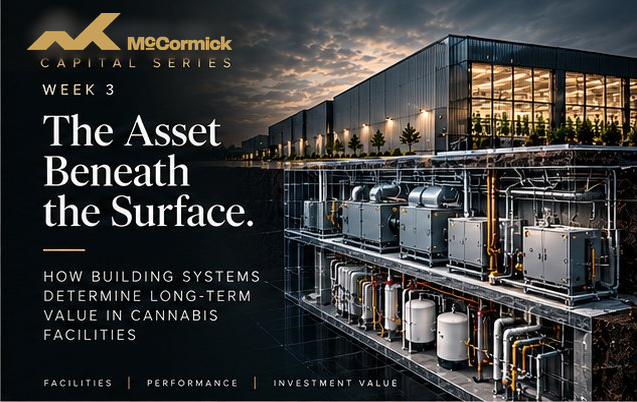
The real value of a cultivation asset often depends on what isn’t immediately visible: the infrastructure supporting production and the cost of operating that infrastructure over time.
For lenders, investors, and facility owners, understanding these systems is fundamental to evaluating long-term asset value.
A Building Is More Than Its Construction Cost
Traditional real estate evaluations frequently focus on location, square footage, replacement cost, occupancy, and comparable properties.
Cannabis cultivation introduces another layer of complexity.
A facility’s economic performance depends heavily on its ability to maintain tightly controlled environmental conditions while managing significant electrical, mechanical, and water demands.
Two cultivation facilities with comparable square footage and production capacity may have substantially different operating costs.
The difference can originate in decisions made years earlier during design and construction.
A lower initial construction cost does not necessarily translate into a better investment.
Five Systems That Deserve Closer Examination
1. HVAC and Dehumidification
Environmental control is among the most consequential infrastructure investments in indoor cultivation.
The evaluation should extend beyond installed cooling capacity to examine dehumidification performance, energy consumption, redundancy, equipment condition, and control strategies.
A system that maintains acceptable conditions under moderate loads may struggle during peak transpiration or seasonal extremes.
2. Electrical Infrastructure
Electrical service capacity, distribution equipment, lighting loads, and available expansion capacity directly influence operational flexibility.
An undersized or poorly configured electrical system can constrain production and create expensive retrofit requirements.
3. Water and Resource Management
Water treatment, irrigation infrastructure, drainage, condensate recovery, and wastewater handling all affect operating costs.
Recovered HVAC condensate deserves particular attention. Condensate may contain contaminants introduced through contact with equipment and distribution surfaces, including metals. Testing and appropriate treatment are necessary before reuse.
4. Building Envelope
Insulation, vapor control, air leakage, and thermal bridging can significantly affect environmental stability and energy consumption.
In northern climates especially, building-envelope decisions can influence the economics of cultivation for decades.
5. Controls and Automation
Sophisticated equipment does not guarantee sophisticated operation.
Poor sequencing, disconnected control platforms, inadequate monitoring, and improperly commissioned systems can undermine otherwise capable infrastructure.
The Hidden Cost of Getting It Wrong
Consider two facilities designed for similar production volumes.
Facility A requires less initial capital but operates with inefficient environmental controls and limited infrastructure flexibility.
Facility B requires a larger initial investment but incorporates appropriately sized systems, integrated controls, and provisions for future modifications.
The financially superior investment cannot be determined from construction cost alone.
The analysis must consider operating expenses, maintenance, reliability, production impacts, and future capital requirements.
A proper evaluation compares the total cost of ownership against the facility’s realistic production economics.
Technical Due Diligence Should Inform Financial Decisions
Before acquiring, refinancing, expanding, or repositioning a cannabis facility, stakeholders should understand:
- Whether existing infrastructure supports the intended cultivation strategy.
- Whether current operating costs are sustainable.
- Which systems are approaching replacement or major maintenance.
- Whether corrective construction can improve economic performance.
- Whether the facility can adapt to future operational requirements.
These questions should be answered before committing additional capital whenever possible.
From Evaluation to Execution
Identifying deficiencies is only the beginning.
An effective technical assessment should distinguish between problems that can be corrected economically and those that fundamentally compromise the investment.
Some assets require relatively targeted improvements. Others need substantial infrastructure replacement or operational redesign.
In certain cases, the cost of repositioning may exceed the value that can reasonably be recovered.
The objective is not simply to identify construction problems. It is to determine which investments can produce a more competitive facility.
The McCormick CEA Perspective
McCormick CEA approaches facility evaluation through the combined lenses of construction feasibility, infrastructure performance, and operating economics.
Our experience designing, constructing, and improving controlled-environment facilities helps connect technical findings to practical implementation strategies.
The value of a cannabis facility is not determined solely by what was spent to build it. It is determined in part by what the building can economically accomplish throughout its useful life.
Evaluate the Infrastructure Behind Your Investment
Whether you’re considering an acquisition, managing an underperforming facility, or planning improvements, McCormick CEA can help evaluate existing infrastructure and identify practical construction and optimization opportunities.
McCormick CEA — Design • Build • Optimize